Most billing problems are not payment problems.
They are model problems.
You are trying to sell one kind of product, but your billing stack forces you into another pricing logic. That is when things start to drift: confusing pricing pages, fragile overage rules, support tickets around top-ups, and product teams arguing about what should happen when users run out.
At Commet, we do not treat all usage-based pricing as the same thing.
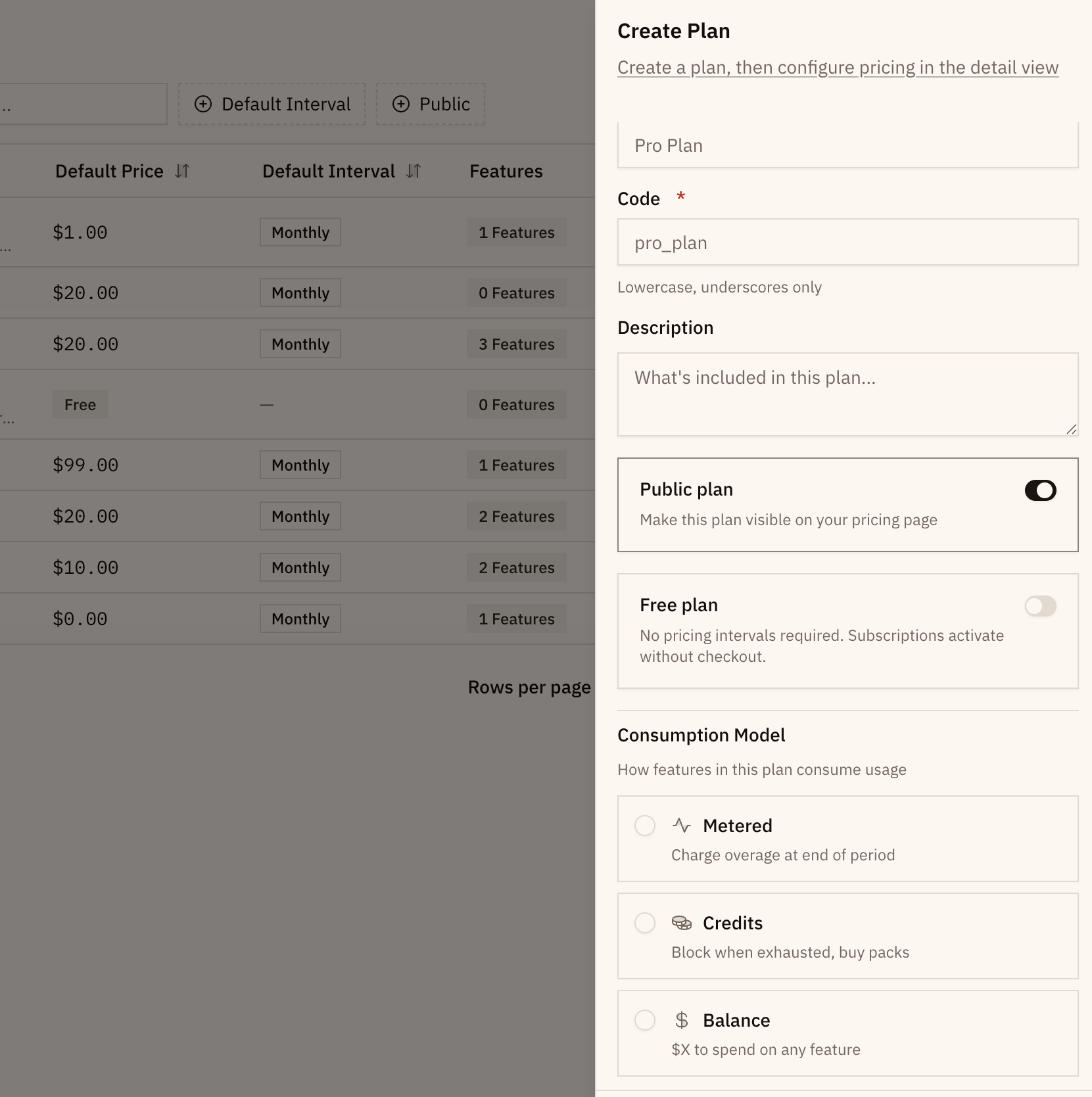
We support three distinct consumption models:
- Metered
- Credits
- Balance
That distinction matters because these are not cosmetic variations. They represent different buying experiences, different customer expectations, and different billing behavior.
One pricing page, three very different products
A SaaS API, an AI image generator, and a cloud platform may all look like "usage-based" products from the outside.
They are not.
A developer buying API access usually expects:
- a base plan
- included usage
- overage at the end of the billing period
An AI product buyer usually expects:
- recurring credits
- visible credit costs per action
- a way to buy more when they run out
A platform buyer usually expects:
- money in
- usage deducted from that amount
- a clear remaining balance they can monitor
Trying to force all three into one billing abstraction usually creates more work for you and more confusion for your customers.
The Commet model: choose the billing logic first
In Commet, every plan uses one consumption model. That keeps the product behavior explicit from day one.
Metered
Metered is the classic SaaS model.
Your customer pays a recurring base price, gets an included amount, and any usage above that limit is charged at the end of the period.
Pay $99/month
Get 10,000 API calls included
Use 14,000
Pay overage for the extra 4,000 at period end
This works well for:
- APIs
- email infrastructure
- developer tools
- products where buyers are comfortable with end-of-period overage
Metered pricing is strong when the usage unit is easy to understand and the customer is not expecting to pre-buy consumption.
Credits
Credits are better for products where consumption is variable, abstract, or intentionally packaged into a simpler buyer experience.
Instead of thinking in raw usage units, the customer thinks in credits.
Pay $49/month
Get 1,000 credits
Image generation costs 10 credits
Voice transcription costs 3 credits
Buy more credits if needed
This works well for:
- AI generation products
- multi-action tools where different actions consume different amounts
- products where top-ups should feel natural
Credits are especially useful when you want the pricing page to stay simple while the underlying cost model is more complex.
Balance
Balance is for products where customers want direct dollar transparency.
They pay a recurring amount that becomes usable balance, and product usage deducts real money from that balance.
Pay $50/month
Start the cycle with $50 in balance
Each action deducts its dollar cost
Add funds if you need more
This works well for:
- infrastructure platforms
- multi-product platforms
- products where "how much money do I have left?" is the clearest mental model
Balance is often the cleanest option when credits would feel arbitrary and metered overage would feel too delayed.
The right question is not "Which one is more flexible?"
The right question is:
How does your customer expect to buy and consume your product?
That usually leads to the right model fast.
Choose Metered if:
- buyers understand the raw unit
- overage at period end feels normal
- you want included usage plus clear expansion pricing
Choose Credits if:
- consumption needs abstraction
- different actions should map to one shared currency
- top-ups are part of the product experience
Choose Balance if:
- buyers want spend visibility in money terms
- usage should deduct from a prepaid amount
- "remaining balance" is more intuitive than credits or overage
Why this matters operationally
Founders usually notice pricing model problems late.
The first version looks fine. Then product grows, pricing evolves, and suddenly your billing behavior is full of special cases:
- extra logic when users run out
- manual handling for top-ups
- unclear customer portal behavior
- inconsistent invoices
- support questions about what resets and what persists
Commet avoids that by making the model explicit inside the plan itself.
That means the portal behavior, feature configuration, and billing lifecycle follow the same rule set from the start.
You are not stitching together one-off billing flows. You are choosing the right commercial model and letting the platform enforce it consistently.
A simpler way to think about plan design
If you are deciding between the three models, ignore billing jargon for a minute and answer these three questions:
- Do customers think in usage limits, credits, or money?
- When they run out, should they see overage, buy more, or add funds?
- Does your pricing page become clearer or more confusing when you explain the model?
If the answer is unclear, your model is probably unclear too.
That is exactly the kind of ambiguity that turns into billing complexity later.
Closing thought
Good billing is not just about charging correctly.
It is about matching the commercial model in your buyer's head.
Metered, Credits, and Balance are different products from a pricing perspective. Treating them that way is what keeps Commet simpler for both the team operating billing and the customer paying for the product.
Read the Consumption Models documentation, learn how to create plans, or try Commet in sandbox.